Service · From €4,000
Apple Home migration in Mallorca
Your existing systems stay exactly where they are. What changes is that the whole house appears in one app — the one already on every phone in your family.
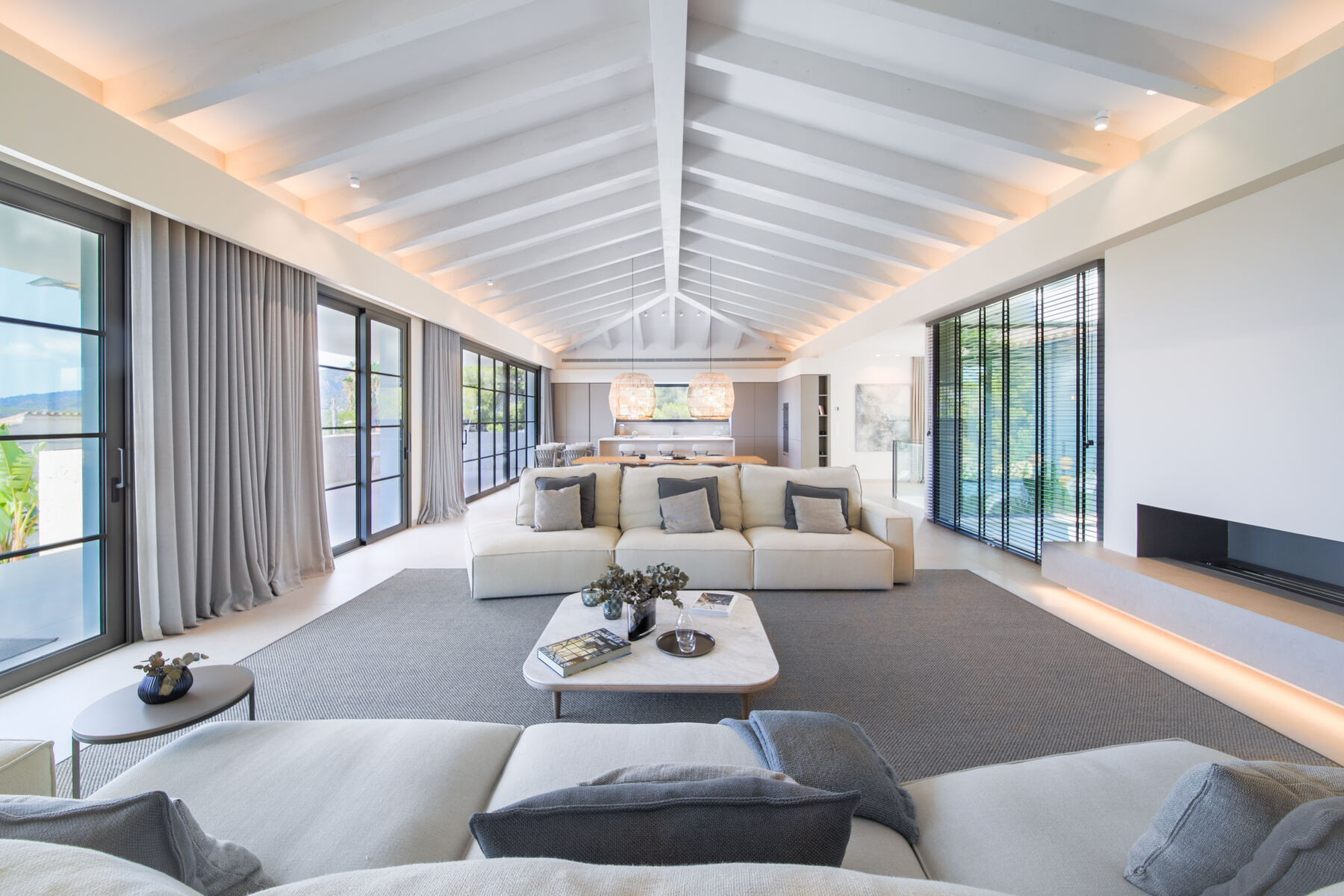
The most common job I do isn't installing a smart home. It's making the one you already paid for usable. Almost every villa I survey on this island has capable equipment in the walls and an interface nobody in the family will touch.
The pattern is remarkably consistent. A good KNX or Lutron installation, put in during the build by a competent installer. Then a wall tablet running a proprietary app, plus a separate app for the music, another for the cameras, another for the gates, and a fifth for the air conditioning. The installer commissioned it once, never documented it, and has since moved on or moved away. Three years later the owner uses the light switches like it's 1995, and the €40,000 system is a decoration.
A migration solves that without touching the fabric of the house. Everything already installed gets bridged into Apple Home, so the whole property appears on the iPhone in your pocket, the Watch on your wrist, the iPad by the bed, and any HomePod you care to speak to.
What actually happens
The engine doesn't change. KNX stays KNX and keeps doing exactly what it always did — that's the point of an open standard, and it's why I recommend it to anyone building new. What gets added is a small local server running Home Assistant, sitting in your plant room, which acts as a translator between the professional systems and Apple's ecosystem. Apple Home sees native accessories. Your KNX bus has no idea anything happened.
Almost everything bridges. KNX, Lutron, Loxone, Sonos, most DALI lighting, Daikin and Mitsubishi climate, Somfy and the common shading motors, Unifi and Hikvision cameras, and essentially any device with a local API. The rare exception is a closed proprietary system with no local interface at all, which the survey identifies before you spend anything.
The network comes first
In nine out of ten houses I look at, the thing making the smart home feel unreliable isn't the smart home. It's the network. Metre-thick stone walls, a consumer router asked to cover 600m² and a garden, wireless access points with no wired backhaul talking to each other over the air, and a 2.4GHz band saturated by every neighbour on the hill.
So the network gets rebuilt as part of the migration, and usually accounts for a third of the cost. Wired backhaul to every access point, proper VLAN separation so the cameras and the guest Wi-Fi aren't sharing a broadcast domain with your laptop, and coverage that actually reaches the pool house and the gate. This is unglamorous and it's the single biggest determinant of whether you like your house in two years.
The tablets usually come off the wall. They're the most common complaint I hear and the least defensible piece of kit in a modern villa: slow, dated, running software the manufacturer stopped updating, mounted in a position that made sense to an electrician. An iPad you already own does the job better, and for most day-to-day use a HomePod and your voice is faster than any screen.
Scenes built around how you actually live
This is the part that takes longest and matters most. A scene called "Evening" that somebody guessed at during commissioning is worthless. The useful version comes from asking what genuinely happens in the house: what time people eat, which terrace gets used in August versus October, whether the guest wing is empty for nine months of the year, what the housekeeper needs, what the property manager should and shouldn't be able to reach.
Out of that you get maybe six scenes people will use every day and a handful of automations that run without anyone thinking about them — shutters that track the sun to keep the west rooms cool, circulation lighting that comes on at 5% after midnight, the pool heating that starts six hours before your flight lands.
What it costs
| Scope | Typical range |
|---|---|
| Survey and written report | €450, credited against the work |
| Apartment or small villa, network already sound | €4,000 – €6,000 |
| Villa, migration plus full network rebuild | €8,000 – €15,000 |
| Large villa with cinema, audio and extensive shading | €15,000 upwards |
| Ongoing managed support | Annual retainer, quoted per property |
Most projects take four to ten days on site. It's a fixed project fee rather than a percentage of what gets spent, so there's nothing in it for me if the specification grows.
Where I work
Across Mallorca — Palma, Son Vida, Bendinat, Portals Nous, Puerto Andratx, Camp de Mar, Santa Ponsa, Calvià, Deià, Valldemossa, Sóller, Pollença, Alcúdia and Santanyí. Selected projects in Ibiza and on the mainland.
Related reading: Apple Home vs KNX — you don't have to choose and why your Wi-Fi dies past the pool house.
Start with a survey
Half a day at the house, €450 fixed. You get a written report on what you have, what's wrong with it and what it would cost to put right — yours to keep whether or not you use me for the work.
Book a survey →Questions
About migrations specifically.
Which systems can be bridged into Apple Home?
KNX, Lutron, Loxone, Sonos, most DALI lighting, Daikin and Mitsubishi climate, Somfy and most shading motors, Hikvision and Unifi cameras, and almost any device with a local API. Bridging is handled by Home Assistant running on hardware in your own plant room, which exposes everything to Apple Home as native accessories.
Do I have to replace my existing hardware?
No. The point of a migration is that everything already in your walls stays there. In a typical project the only hardware added is a small local server, network equipment, and occasionally a HomePod or two. The wall tablets usually come off, but nothing is ripped out of the fabric of the house.
How long does it take?
Most take between four and ten days on site, depending on house size and how much network work is needed. The survey happens first and tells you the number before you commit. Larger villas with cinema and extensive shading can run to three weeks.
What if an iOS update breaks something?
This is the argument for a support retainer rather than a one-off job. Updates do occasionally change behaviour. With monitoring in place the problem is usually spotted and fixed before anyone in the house notices — which is exactly how Apple devices are managed in a business.
Will it still work if the internet goes down?
Yes. Everything critical runs locally — KNX and Lutron were never internet dependent, and both Home Assistant and Apple's home hubs process automations on site. Losing the connection means losing remote access from off the island, not losing your lights.
Get in touch
Start with a survey.
Half a day at the house, €450 fixed, and an honest written view of what you've got. Credited in full if you go ahead.